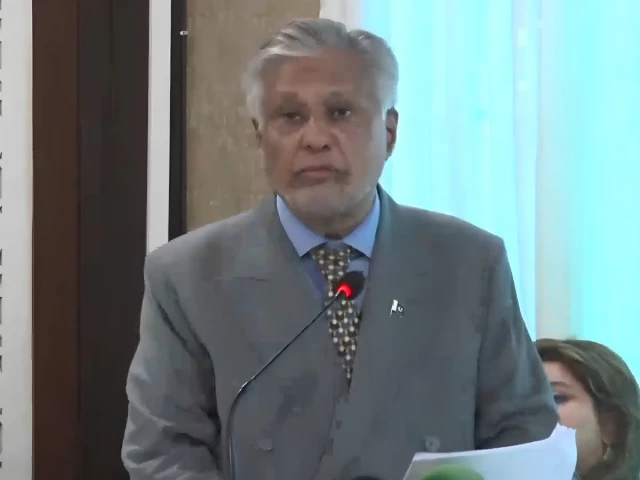
Deputy Prime Minister and Foreign Minister Ishaq Dar addressing the CODEL and US Business Delegation, July 28, 2026. SCREENGRAB
ISLAMABAD:
Pakistan, Saudi Arabia, Türkiye and Egypt are set to hold another round of high-level consultations in Istanbul later this month, as Islamabad steps up diplomatic coordination with key regional powers following the signing of a landmark defence agreement between Pakistan, Saudi Arabia and Türkiye.
Turkish Foreign Minister Hakan Fidan invited Deputy Prime Minister and Foreign Minister Ishaq Dar to Istanbul for a meeting of the foreign ministers of Pakistan, Türkiye, Saudi Arabia and Egypt. The invitation was extended during a telephone conversation between Dar and Fidan on Wednesday, according to the Foreign Office.
The planned meeting of the four foreign ministers was also discussed when Dar chaired a meeting at the Foreign Office to review preparations for upcoming high-level visits and engagements.
The four countries have been coordinating under the R-4 framework, which was launched earlier this year to intensify consultations on regional crises, particularly the conflict involving the United States and Iran and broader efforts to promote regional stability. The grouping has held several meetings since March, with its fourth ministerial meeting taking place in Cairo in June.
The latest meeting of the four foreign ministers was held in Amman on August 5 on the sidelines of a ministerial meeting on Jerusalem. Dar, Saudi Foreign Minister Prince Faisal bin Farhan, Turkish Foreign Minister Hakan Fidan and Egyptian Foreign Minister Badr Abdelatty discussed the regional situation and called for continued consultation and coordination.
The Istanbul meeting, however, assumes added significance because it will be the first major R-4 engagement since Pakistan, Saudi Arabia and Türkiye signed the Makkah Joint Defence Agreement on August 7.
The agreement commits the three countries to collective defence, with an armed attack against one member to be treated as an attack against all. Pakistan and Türkiye have stressed that the pact is defensive in nature and is not directed against any particular country. The agreement also envisages deeper military coordination, joint exercises and cooperation in defence technology.
Egypt’s potential participation had emerged as an important question in the run-up to the Makkah agreement. Turkish officials had indicated that Cairo could eventually join the new defence arrangement, given its military weight and strategic importance in the region. However, Egypt did not become a signatory when Pakistan, Saudi Arabia and Türkiye concluded the pact in Makkah.
The upcoming four-way meeting therefore provides an opportunity to assess whether Egypt could have a role in the evolving regional security architecture without necessarily becoming a formal member of the defence pact.
For Pakistan, the Istanbul talks also come at a time when Islamabad is seeking to maintain close coordination with both Gulf Arab states and Türkiye while keeping its diplomatic channels open with other regional actors.
Officials familiar with the diplomatic process say the discussions are expected to cover the rapidly changing security situation in the Middle East, the future of the R-4 mechanism and ways of strengthening political and diplomatic coordination among the four countries.