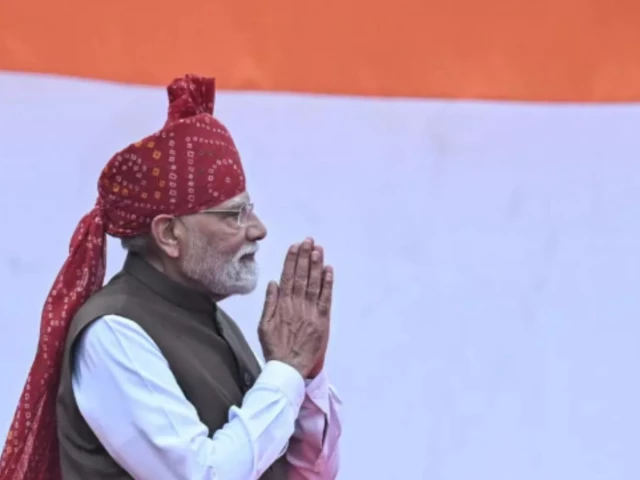
Prime Minister Narendra Modi’s government has sought to appease young Indians after major protests. PHOTO: AFP
Indian Prime Minister Narendra Modi said Saturday his government would provide free online coaching lessons for competitive exams, weeks after massive youth-led protests forced the education minister to resign.
Modi said the initiative was aimed at easing the financial burden on millions of families caught up in the country’s fiercely competitive education system.
The 75-year-old leader made the announcement while speaking from the ramparts of New Delhi’s imposing 17th-century Red Fort to mark the country’s independence from Britain on August 15, 1947.
“We have decided to provide free online coaching for various competitive examinations for our youth. We have the digital public infrastructure, and we have highly talented teachers and educators,” he said.
The move comes after nationwide protests triggered by the leak of a key medical entrance examination paper and a series of other recruitment scandals.
The protests, which culminated in the resignation of education minister Dharmendra Pradhan last month, exposed deep frustration among young Indians over access to jobs and educational opportunities.
They also highlighted immense pressures on students in India, the world’s most populous nation where admission to government-run colleges remains one of the most sought-after pathways to economic security.
Read: India’s ‘cockroach’ protest movement keeps heat on Modi
The cut-throat competition has fuelled a sprawling coaching industry where students spend years preparing, often at enormous financial cost for their families.
Modi said the free online classes would ease financial burden on “poor and middle-class families”.
“The competition surrounding coaching classes has become a huge burden for middle-class families… (Students) can stay close to their families, receive their care, and avoid placing an additional financial burden on them,” he said.
Modi also announced plans to train several million young people in artificial intelligence tools. “We have decided in the next one year, one crore (10 million) youth will be given training in AI skills,” he said.
Since the protests, authorities have attempted to appease the nation’s youth, with the parliament hiking penalties for leaking exam papers.
Critics say the protests posed one of the biggest challenges to Modi’s government since coming to power in 2014.
Growth framework
In a speech lasting more than an hour, Modi also reiterated his government’s vow to help India achieve the status of a developed country in the next 20 years, announcing a seven-point growth and reform framework.
The initiative would focus on manufacturing, agriculture, technology and defence, as well as India’s “soft power” through yoga, tourism and handicrafts.
India, Asia’s third-largest economy, must “establish itself as a trusted global supply chain partner for the world”, Modi said of manufacturing.
Read More: India’s Modi turns to Instagram to woo young voters after Gen Z protest
In the coming years, he said India will have eight more semiconductor chip plants and five nuclear reactors which will generate 100 gigawatts of power by 2047.
Last year, the government allowed private firms to build and operate atomic power projects, underlining a push for alternative energy.
Modi said young people stood to gain the most from his vision for development.
“The youth have a big role to play in the journey towards a developed India…the greatest beneficiary of a developed India is the youth of the country.”