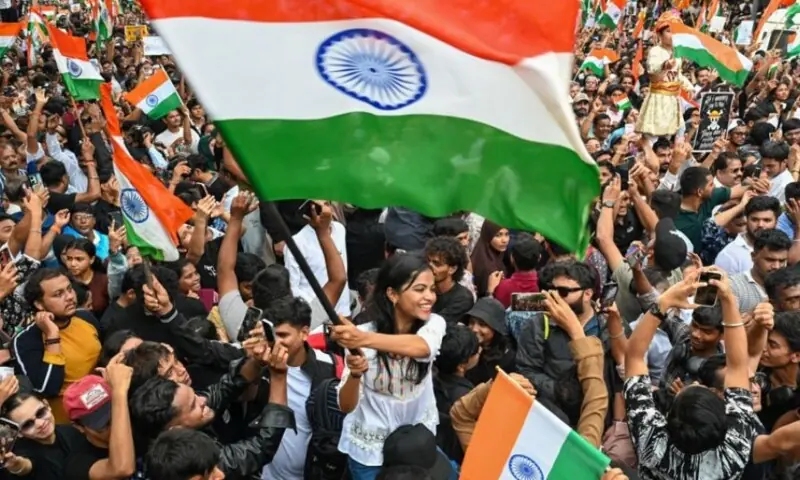
The Narendra Modi-led government has often declared proudly that its ministers do not resign under public pressure, unlike those from previous governments.
However, that hubris was shattered on July 25 when Dharmendra Pradhan, India’s education minister, was forced to resign following widespread youth anger and resistance galvanised by the successful protest in New Delhi led by the Cockroach Janta Party (CJP).
The first such capitulation by a cabinet minister since Modi came into power in 2014 has prompted questions on the wider political impact of this youth-led movement on the ruling Bharatiya Janata Party (BJP) ahead of key state elections, including in India’s most populous state of Uttar Pradesh, in 2027.
While CJP maintains it has no immediate plans to transform itself into a political party, its unprecedented success and continuing pressure on the government has not only dented Modi’s invincibility but also revitalised the opposition, both on the streets and in Parliament.
Modi biography author and political commentator Nilanjan Mukhopadhyay described the successful protests as “a big blow to Modi’s strongman image”, as well as “possibly a big turning point in Indian political history”.
“The fear of the regime has now gone,” he told The Straits Times, noting how young people continued protesting despite being beaten with batons by the police, tear-gassed and even fired upon with pellet guns by paramilitary forces.
Mukhopadhyay said Pradhan’s resignation had also reignited the popularity of youth-led protests that “had faded from public minds”.
“The romanticism of the idea of a protest has come back in a big way after several decades in India,” he added.
This could encourage similar protest movements on other issues by other groups, further mobilising public anger and potentially creating problems for the government, he noted.
India’s opposition parties have latched on to the momentum generated by these protests and kept the pressure up on the government.
On July 29, Congress leader Rahul Gandhi directed his criticism in Parliament at Home Minister Amit Shah, who controls Delhi Police, as well as the country’s paramilitary forces, demanding that he, too, resign for having “ordered the shooting of our students”.
BJP has denied this charge. “On what basis are you saying this?” shot back Parliamentary Affairs Minister Kiren Rijiju.
CJP founder Abhijeet Dipke echoed Gandhi’s demand on July 30, alleging that the July 20 attacks on protesters during their attempted parliament march against examination irregularities were carried out on Shah’s instructions.
Why did the government give in to CJP’s demands?
Analysts have said that the government’s decision to accede to CJP’s demands was prompted by fears that further repression of the protests could harm BJP’s support base among the youth.
Around 39 per cent of voters between the ages of 18 and 25 had voted for BJP in the 2024 general election, giving it the largest youth vote share among all political parties.
Yet, BJP failed to gauge the groundswell of anger among young people, especially over exam paper leaks. Even children of BJP ministers and allies either joined the protest or expressed support online.
At Jantar Mantar, the protest site in New Delhi, young people coalesced across different religions and social groups – 30-year-old Dipke himself is a Dalit, a marginalised Hindu caste. The protesters also couched their opposition with patriotism and belief in India’s constitutional ideals, a heady mix that proved difficult for BJP to counter.
Modi, who came under direct attack from the outspoken youth, has sought to limit the damage with several actions. These include the passage of an anti-paper leak legislation in the lower house of Parliament on July 29, as well as the creation of a task force to set up a leak-proof examination system.
The prime minister also released a series of informal, selfie-style vertical videos to reach out to young people and urged his ministers to be more active on Instagram.
CJP has criticised these moves, with Dipke saying that Modi should quit the prime minister’s post and instead “become an influencer”.
CJP and other protesting youth-led groups have also questioned the effectiveness of the new measures, arguing that they do not focus on factors that lead to examination paper leaks in the first place and fail to fix accountability at top levels of the government.
The groups have also kept up their campaign to ensure that students and other protesters are released from captivity and have charges against them dropped, something that was agreed to between the government and CJP.
“This government must understand that the students’ anger has not subsided. There is immense anger among the people, and if required, protests will happen again and be bigger than the previous one,” CJP posted on X on July 29.
Faced with these threats, the authorities have stepped up security around Jantar Mantar, even welding metal barricades together for better reinforcement against protesters.
The successful protest has reinvigorated several other youth-led organisations that had existed for decades before CJP came into being in May 2026 and had rallied together to support the movement at Jantar Mantar.
Among them is the left-leaning All India Students’ Association. Its president, Neha, who prefers to use only her first name, said: “The win is, of course, the resignation of an incapable education minister, but it is also a win that… not even BJP, after more than 10 years of being in power, can say we are beyond democracy and our Cabinet ministers need not concern themselves with serving the public.
“It has shown us that BJP can be defeated by the combined might of the people of this country. And it gives us hope for the several other battles that have been continuing so far and where we’ve not yet registered victory.”
In recent days, copycat protests by schoolchildren demanding better education facilities at government schools have erupted in three states – Uttar Pradesh, Bihar and Rajasthan. Some protesting youth groups even returned to Jantar Mantar on July 29 to condemn the “police crackdown” on protesters in BJP-governed states such as West Bengal, Bihar and Assam.
BJP fights back ahead of state polls
Meanwhile, the government has also put up a fight – with the authorities asking social media platforms to take down posts critical or abusive of Modi, and pro-BJP social media users even trying to dox students who had criticised the Prime Minister openly on camera.
BJP leaders even gave Pradhan a rousing welcome at Parliament on July 26, a day after his resignation. “They are certainly not bowing down,” said Mukhopadhyay, noting there are legitimate fears of further “repression (by BJP) and tightening of the noose around democracy”.
The first big electoral test following these protests will come in the first quarter of 2027, with state elections in Uttar Pradesh, which is currently governed by BJP.
Amitabh Tiwari, a political strategist and founder of Vote Vibe, an opinion polling agency, said the protests reflect a malaise beyond just paper leaks, including issues such as youth unemployment.
He added that while they pose an electoral challenge to BJP, the protests had also highlighted the opposition’s failure to take up these longstanding concerns effectively and draw public support the way CJP had with an estimated tens of thousands of protesters on the ground and millions of followers online.
“If the credit itself has not accrued to the opposition parties for these protests and resignation, I feel it is unlikely that the electoral benefit could accrue to them,” said Tiwari.
Opposition parties, he noted, have to go beyond mere criticism of the government and must offer tangible solutions for youth-related concerns to translate youth anger into votes.
“That is a missing link. If they do that, then, of course, they could see some gains,” he added.
A pushback against gerontocracy
Tiwari told ST the protests are also a warning sign for India’s gerontocracy that has failed to give young people a fair share in governance and take up their issues.
“The youth are saying our voice is unheard in this entire political system, that India is a young country but one that is ruled by grandfathers and grandmothers,” he said.
India has a young population, with a median age of 29 years, but the average age of MPs elected in 2024 stood at 56 years.
Nearly 50 per cent of the 1,000-plus respondents of a snap poll conducted in Indian cities by Vote Vibe in June had said that there potentially exists a political space for a party focused mainly on youth-related concerns.
“I see it as a call for, rather than a threat to, political parties to give more representation to youth in their ecosystems,” said Tiwari. “And if that does not happen, they’re signalling that they can align with forces like CJP were they to plunge into politics in the future.”
This article originally appeared on The Straits Times, an ANN partner of Dawn.