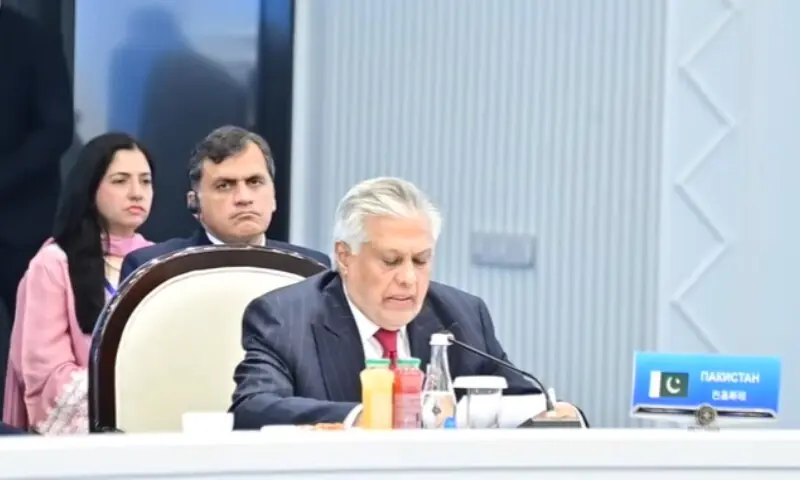
Deputy Prime Minister and Foreign Minister Ishaq Dar said on Friday that durable peace and stability in the region can only be achieved by eliminating the threat of terrorism emanating from neighbouring Afghanistan.
“Durable peace, stability and economic development can only be achieved with the eradication of the menace of terrorism emanating from Afghan soil,” he said while speaking at the Shanghai Cooperation Organisation (SCO) Council of Foreign Ministers’ meeting.
He said that Pakistan desired to see a “peaceful, stable, regionally integrated and prosperous Afghanistan which is at peace with itself and its neighbours”, adding that this would be in the best interest of all SCO member states and beyond.
He said that currently, the threat of terrorism emanating from Afghanistan was one of the most serious security challenges for Pakistan. He said that terrorist organisations continued to recruit, train and operate from Afghan soil “under the watch and facilitation of the Afghan Taliban regime”.
He said that this support was “well-documented”, adding that Pakistan was at the forefront of this threat. He added that this year alone, more than 560 Pakistanis have been killed in over 2,000 terrorist attacks.
“It is also deeply concerning that Afghan nationals have been found to be involved in these terrorist incidents,” the minister said.
He urged the SCO to demand the Afghan Taliban regime to “honour its counter-terrorism commitments to the international community and fulfil its responsibilities towards global peace and security”.
During his remarks, Dar said that since its establishment, the SCO has become “an anchor for regional cooperation, driving vital progress in peace, security, stability and economic connectivity while also simultaneously fostering deep cultural exchanges among member states“.
He said that over the last 25 years, the SCO had transitioned from a security-centric Shanghai Five to a “comprehensive entity that integrates security, economy, development, culture and peace among others”.
Looking towards the future, Dar said, the SCO’s development strategy for the next decade should focus on digital inclusivity, bridging technological divide and ensuring energy security.
Dar meets Kyrgyz president, China’s foreign minister
Separately, Dar also met Kyrgyz Republic President Sadyr Nurgozhoevich Zhaparov and China’s Foreign Minister Wang Yi.
Regarding the meeting with Wang, the Foreign Office (FO) said, “The two leaders held a warm and productive exchange of views on bilateral relations, regional developments, and cooperation within multilateral forums.”
It said Dar thanked Wang for “appreciating Pakistan’s diplomatic efforts for regional peace and stability”. It added that Wang conveyed his best wishes to Pakistan for its upcoming chairmanship of the SCO Council of Heads of State (CHS) and hosting of the SCO Summit in 2027.
Dar also called on Kyrgyz Republic President Zhaparov along with the foreign ministers of other SCO states.
The FO said Dar thanked Zhaparov for the hospitality extended during the SCO meeting.
“The interaction covered regional and global developments, as well as the evolving role of the SCO as an important platform for cooperation,” it said.
DPM Dar also underscored “the importance of continued collaboration among SCO member states as Pakistan prepares to assume the SCO chairmanship for 2026–27.”
Initially formed as a security cooperation group in 2001, the SCO has now evolved into a forum for trade and economic development in the region.
The SCO comprises 10 member states, namely India, Iran, China, Pakistan, Russia, Kyrgyzstan, Belarus, Kazakhstan, Tajikistan and Uzbekistan. The two observer states are Afghanistan and Mongolia.
Earlier this month, President Asif Ali Zardari and Kyrgyzstan’s Zhaparov reaffirmed their commitment to boosting bilateral ties between Pakistan and Kyrgyzstan, particularly deepening trade, economic and investment cooperation.