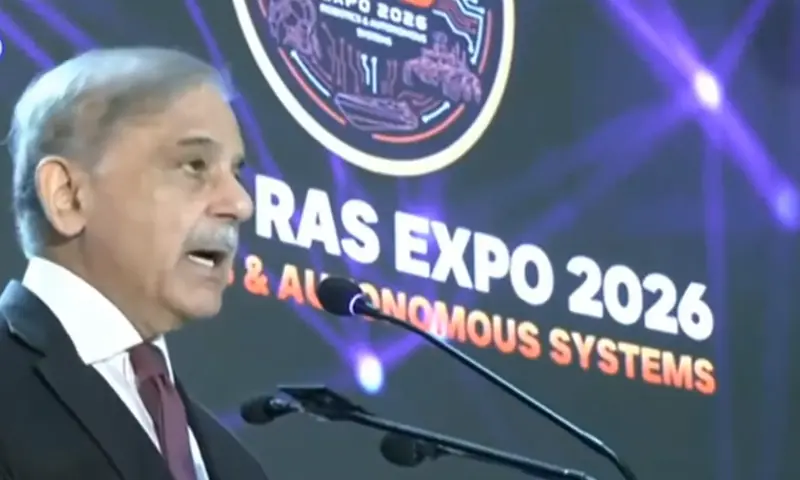
Prime Minister Shehbaz Sharif on Wednesday noted that Pakistan’s military advancements in indigenous defence capabilities were an “integral part” of its national defence.
He made the remarks at the two-day Indus Robotics and Autonomous Systems (RAS) Expo 2026 that opened today at the Pak-China Friendship Centre in Islamabad.
Addressing the event, PM Shehbaz noted that Pakistan has “made remarkable progress in developing indigenous autonomous capabilities in the field of defence and security under the dynamic leadership” of Chief of Defence Forces (CDF) and Chief of the Army Staff Field Marshal Syed Asim Munir.
He recalled that during the conflict with India in May 2025, the “valiant armed forces resolutely guarded our physical and cyber frontiers through the highly effective use of advanced autonomous systems” led by the CDF and supported by the air and naval chiefs.
PM Shehbaz declared that “these remarkable military advancements are an integral part of our national defence”.
He said they would “strengthen our security architecture, make our defence more impregnable and enhance our resilience against emerging and future threats”.
“Our brave armed forces proved beyond any ray of doubt that Pakistan possesses not only the iron resolve to safeguard its sovereignty but also the indigenous capability, technological prowess and operational excellence required to employ advanced autonomous technologies in defence of our motherland,” he stated.
The prime minister noted that the armed forces have adopted “cutting-edge technologies”, adding that he witnessed some of those on display at the expo. “Remarkable achievement,” he said.
He added that he also took a look at simulators that were “100 per cent manufactured and assembled in Pakistan”. He noted that drones had achieved 60pc indigenisation and “many other important machines” have been made in Pakistan.
PM Shehbaz said the Indus RAS Expo has “unveiled the future of Pakistan, designed, built and powered by great Pakistanis”.
He called for universities, research and development centres, start-ups, industries and farmers to become part of a single “national innovation ecosystem” to ensure that the knowledge behind these technologies would advance continuously.
The premier stressed that the RAS “revolution must not remain the privilege of a few advanced economies, large corporations or major cities”.
“It must become a force for inclusive growth, improving the lives of farmers, small businesses, women entrepreneurs, young innovators and underserved communities across Pakistan and the Global South,” he asserted.
At the same time, the prime minister underscored the need to establish “clear, regulatory and ethical frameworks to ensure autonomous systems are safe, secure, transparent and always used for the benefit of mankind”.
Two ‘landmark’ initiatives launched
In his address, PM Shehbaz announced two “landmark initiatives” that would help shape the future of RAS in Pakistan.
The first was the ‘Spark and Elevate Programme’ that would aim to transform “Pakistan’s research into world-class technologies, globally competitive enterprises and highly productive jobs”.
The second initiative, the premier announced, was the ‘Pakistan Venture Fund’ with an initial commitment of $20 million to “catalyse investment into our technology ecosystem”.
He remarked that Pakistan sought a future of robots and autonomous machines to “reimagine, to compete and to build a better future to come”.
“Pakistan will not be a nation that merely inherits the choices made by others. We will shape our own destiny,” he affirmed.
At the outset of his address, PM Shehbaz recalled the Indus AI Week held in February to “shape Pakistan’s journey” in the age of artificial intelligence.
“Today, the Indus RAS Expo gives that vision its tangible form, demonstrating how innovation can be translated into viable solutions that strengthen our economy and improve the lives of our people,” he said.
The premier observed: “Today, technology has taken flight quite literally. We stand at an extraordinary moment in history where machines no longer merely calculate; they can perceive, decide and act swiftly.
“What once belonged to the realm of imagination has become part of our everyday reality.”
Noting that farmers worked at the mercy of nature and faced water scarcity amid climate change challenges, he said, “Today, an intelligent machine flying low over a wheat field has the potential to solve these complex challenges.
“It detects crop stress early [and] determines with incredible precision where exactly water, fertiliser, and pesticides are needed,” he elaborated.
PM Shehbaz also highlighted the use of such innovation in flood-hit areas: “When crisis hits, the same technology provides access and helps save lives where roads and bridges are completely washed away.”
IT Minister Shaza Fatima Khawaja also addressed the expo. She highlighted the government’s initiatives aimed at promoting digitalisation and the tech sector.
Pakistan TV quoted her as saying that the government was fostering an ecosystem where startups can scale.
Noting that technological leadership now defines national sovereignty, the minister called for a structured approach and stronger financing mechanisms to advance deep technologies.